
如意精舍RU-YI MEDITATION
Quarter 1 Week 1

Right Effort in Gratitude

正精進的感恩 · The Laughing Buddha 歡喜佛

本週重點

Overview

💬 English Goal

英文目標

Use the patterns “I feel…” and “I am grateful for…” to express feelings, and learn positive vocabulary: grateful, joyful, effort, diligent, present. Use the simple present tense for daily habits.

🪷 Spiritual Goal

佛學/心靈目標

Understand Right Effort (Sammā Vāyāma) as the steady cultivation of wholesome states like gratitude and joy — and connect “letting go” of pressure (the Laughing Buddha) with awareness of the present moment.

單字 Vocabulary

點 🔊 聽發音

聽、跟著念、大聲說三次。

grateful(adj.)感恩的
effort(n.)努力/精進
diligent(adj.)勤奮的
joy(n.)喜悅
laughter(n.)笑聲
present moment(n.)當下
enlightenment(n.)覺悟

句型 Sentence Patterns

Key Patterns
Pattern 1 · Saying how you feel
I feel ___.

I feel happy.

I feel joyful and calm.

I feel present when I breathe slowly.

Pattern 2 · Saying thank you
I am grateful for ___.

I am grateful for my teacher.

I am grateful for my family, because they are kind.

Pattern 3 · Daily habits (simple present)
I ___ every day.

I study English every day.

Consistency requires effort.

✏️ Grammar Focus · Simple present for habits

We use the simple present tense to talk about things we do again and again. Add -s for he / she / it: She studies every day. · He works hard. Right Effort means doing a little, consistently — not everything in one burst.

故事 The Story

Story
This week’s visual: How to feel happy every day — effort, gratitude, and the present moment.

Long ago in China there lived a wandering monk named Budai (布袋和尚). He was round and cheerful, and he carried a big cloth bag everywhere he went. People called him the Laughing Buddha because he was always smiling.

Inside his bag he kept small gifts for children, and he gave them away wherever he traveled. He owned almost nothing, yet he was the happiest person in every village. When people asked him the secret of happiness, he simply put down his bag and laughed.

The bag was heavy — like the worries and pressure we carry in our minds. Budai showed that we can work hard and walk far, and still set the bag down and rest in the present moment with a joyful heart. That is the balance of Right Effort: try your best, and let go of the stress.

🤔 Check your understanding

  • Why did Budai carry a big bag? 他為什麼背著大袋子?
  • Why do people call him the Laughing Buddha? 為什麼叫他「歡喜佛」?
  • What does “putting down the bag” mean for you? 「放下袋子」對你來說是什麼意思?

佛法小品 The Principle

Principle

Watch this short film, The Ru-Yi Method, then think about how effort and joy work together.

🌟 Effort, the Middle Way 中道的精進

Right Effort is not pushing yourself until you break, and it is not being lazy. It is the steady, kind effort of doing a little every day — and meeting each moment with gratitude. When you study English with joy instead of fear, the words come more easily. Diligence and laughter belong together.

練習 Practice

Homework

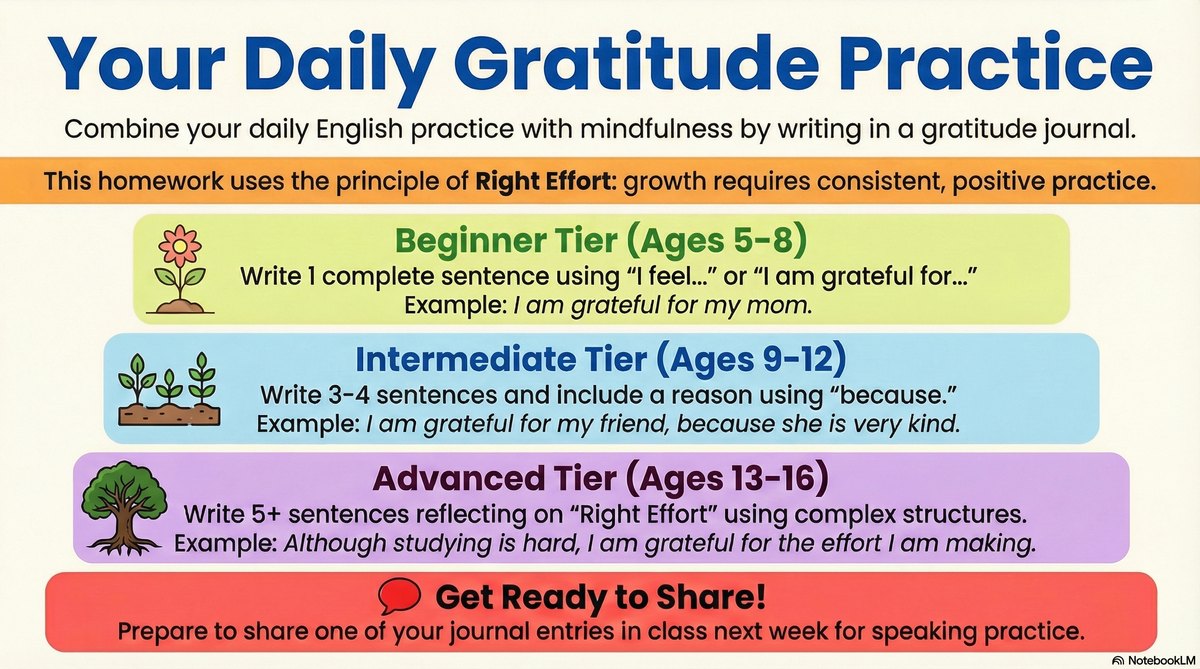
Write in your journal every day this week. Choose the tier that fits you — the daily practice is the Right Effort. 每天寫一篇,選一個適合自己的等級。

Beginner 入門

One sentence

Ages 5–8 · new learners
Write 1 sentence using “I feel…” or “I am grateful for…” plus a vocabulary word. Name one happy feeling.
ExampleI am grateful for my mom. I feel joy.
Intermediate 中級

3–4 sentences

Ages 9–12 · developing fluency
Write 3–4 sentences. Use a simple-present verb and a reason with because. Connect the gratitude to a feeling and a person.
ExampleI am grateful for my friend, because she is very kind. We played a game today. I feel joyful.
Advanced 進階

5+ sentences

Ages 13–16 · fluent speakers
Write 5+ sentences using a complex structure (although, when, since) and reflect on the Right Effort principle.
ExampleAlthough studying is hard, I am grateful for the effort I am making. I feel present and peaceful when I laugh.

小考 Mini Quiz

Check Yourself

選出最適合的答案,點選後會看到解析。

Question 1 of 10
Which word means “感恩的 / thankful”?
Correct: B. Grateful means thankful (感恩的). Diligent = hard-working; present = here, now.
Question 2 of 10
Complete the feeling: “I ___ joyful today.”
Correct: C. We say “I feel + (feeling word).” → I feel joyful.
Question 3 of 10
Choose the correct sentence to give thanks.
Correct: D. The pattern is “I am grateful for ___.” Don’t forget the word for.
Question 4 of 10
Habits use the simple present. Which is correct?
Correct: A. For he / she / it, add -s (and study → studies).
Question 5 of 10
In English, the Laughing Buddha’s big bag stands for our…
Correct: C. The heavy bag is a picture of the worries and pressure we carry. “Putting it down” means letting go of stress.
Question 6 of 10
“Right Effort” (Sammā Vāyāma) means…
Correct: D. Right Effort is the Middle Way — consistent, kind effort, not one big exhausting burst.
Question 7 of 10
Which word means “當下 / here and now”?
Correct: A. The present moment = 當下. Enlightenment = 覺悟; laughter = 笑聲.
Question 8 of 10
A diligent student is one who…
Correct: B. Diligent (勤奮的) describes someone who works hard and steadily — the heart of Right Effort.
Question 9 of 10
Add a reason: “I am grateful for my friend ___ she is kind.”
Correct: C. Because introduces a reason: “…grateful for my friend because she is kind.”
Question 10 of 10
What lesson does the Laughing Buddha teach about studying?
Correct: D. Diligence and laughter belong together — try your best and set down the heavy bag of pressure.